

There are cities that you visit. And there are cities that you read like a book.
Segovia belongs to the second category.
Every stone tells a different chapter of its history. The Roman Aqueduct speaks of the ambition and engineering genius of Rome. Its medieval streets tell the story of the three cultures that shaped Spain. The Alcázar recalls the days when the kings of Castile chose this city as one of their favorite royal residences. And the Cathedral tells the story of a city that, even as its political power began to fade, still had the wealth, pride, and confidence to build one of Europe’s most breathtaking churches.
The story of Segovia is not the story of an ordinary city. It is a story of rise and decline, of emperors and kings, of merchants and craftsmen, of civil wars, empires, and a beauty that managed to survive the passing of time.
The Roman Aqueduct: When Rome Chose Segovia
The first question every visitor should ask while standing before the Aqueduct is simple:
Why did the Romans build such a colossal masterpiece of engineering in what today seems like a small city in the heart of Spain?
The answer lies in geography.
Before Rome, a Celtic settlement already existed here, controlling an important route across the Iberian plateau. But it was the Romans who recognized its full potential.
The city was protected by the deep valleys of the Eresma and Clamores rivers, controlled strategic routes, and, above all, had access to the most valuable resource of all: water.
The snow that covers the Sierra de Guadarrama for many months of the year feeds springs and streams that made one of the greatest engineering achievements of the ancient world possible.
Almost two thousand years ago, the Romans created a system that carried this water over many kilometers into the heart of the city. The most astonishing fact is that it still stands today.
When we look at the Aqueduct, we are witnessing a conversation between nature and human intelligence that has lasted for twenty centuries.
The Fourth Monument: The Streets That Preserve a Thousand Lives
Many visitors look up to admire Segovia’s great monuments but forget to look down at the ground beneath their feet.
Its narrow, winding, cobblestone streets are perhaps its most human monument.
In some corners, visitors may feel as if they are walking through a maze similar to an old North African city such as Marrakech. Not because Segovia was a great Islamic city—it was not—but because medieval cities developed organically, adapting to the terrain, property boundaries, and the needs of their inhabitants.
Through these streets walked Mudéjar craftsmen, Jewish merchants, wool traders who made Segovia one of Castile’s richest cities, noblemen, soldiers, and ordinary citizens.
The great monuments were built by emperors, bishops, and kings. These streets were built by everyday life.
The Alcázar: When Segovia Was Close to the Center of Power
During the Middle Ages, Segovia experienced its greatest period of splendor.
It was never the official capital of Castile because medieval Castilian kings had no permanent capital. The royal court moved from one city to another. However, Segovia became one of the favorite residences of the Trastámara dynasty.
The reasons were clear: security, wealth, beauty, and nature.
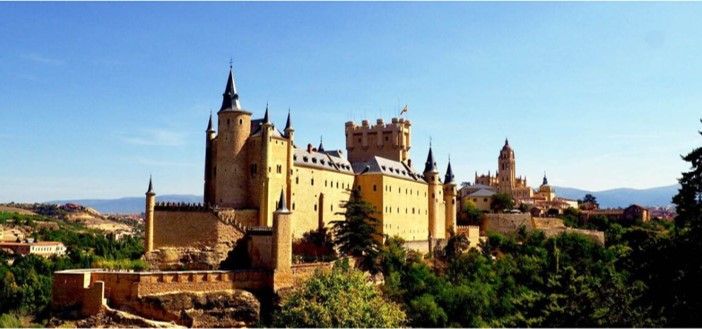
The Alcázar, built on a dramatic rocky cliff between two valleys, was one of the most defensible royal fortresses in Castile. The nearby forests of Valsaín offered exceptional hunting grounds, and the wealth generated by the fine merino wool trade turned Segovia into one of the most prosperous cities in the kingdom.
Within these walls, kings lived, princes were born, and decisions were made that would eventually transform the world.
In 1474, a young woman named Isabella made a decision that revealed her extraordinary character. She did not wait for her husband Ferdinand. She proclaimed herself Queen of Castile in Segovia and began a political journey that would lead to the conquest of Granada, the Atlantic expansion, and the creation of a global Spanish Empire.
The Cathedral: The Last Great Dream of a Powerful City
The Cathedral we admire today is not the one Isabella knew.
The original medieval cathedral stood next to the Alcázar and was destroyed during the War of the Comunidades in the early 16th century—a conflict that symbolized the struggle between the old medieval Castile and the emerging imperial monarchy of Charles V.
The people of Segovia then made an extraordinary decision: they would build an even larger and more beautiful cathedral.
This is one of Segovia’s greatest paradoxes.
The city created its most elegant monument precisely at the moment when it was beginning to lose its political importance.
The wool trade still provided enormous wealth, but the world was changing. Atlantic commerce was growing, the royal court would eventually settle permanently in Madrid, and the importance of the wool industry slowly declined.
Segovia went from being a city where kings lived to becoming a treasure frozen in time.
A Final View from Zamarramala
There is one place where all of this history can be understood at a single glance.
From Zamarramala, Segovia appears like a painting that summarizes two thousand years of human history.
On one side stands the Alcázar, like the stone prow of a great ship sailing above the valleys of the Eresma and Clamores rivers.
At the center rises the Cathedral, a symbol of the pride of a city that refused to disappear.
Behind it, the snowy peaks of the Sierra de Guadarrama remind us of the source of the water that made the Roman Aqueduct possible.
And between all these monuments lies the true heart of Segovia: its medieval streets, where one can still imagine the footsteps of Romans, Visigothic bishops, Jewish scholars and merchants, Mudéjar craftsmen, wool traders, kings, queens, and soldiers.
Perhaps that is Segovia’s greatest miracle.
The city lost its political power. It lost its economic dominance. The kings eventually left.
But it gained something that very few places on Earth possess: the ability to preserve, within a single landscape, two thousand years of history.
That is why Segovia is not simply a city to visit.
It is a city to remember.